
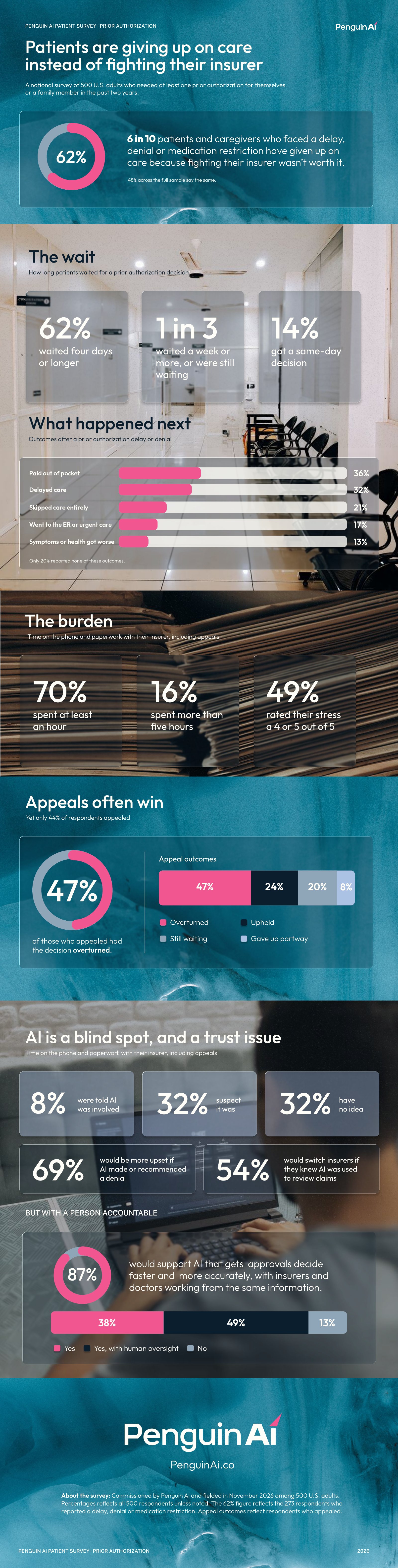
Penguin Ai surveyed 500 U.S. adults on prior authorization. One in three waited a week or more. Only 44% appealed, and 47% of those who did won.
Penguin Ai surveyed 500 U.S. adults who needed at least one prior authorization for themselves or a family member in the past two years. We asked how long they waited, what happened next, what it cost them in time, and what they think about AI in the process.
The wait
One in three waited a week or more for a decision, or were still waiting when we asked. 14% got an answer the same day.
What happened next
After a delay or denial, 36% paid out of pocket. 32% delayed care. 21% skipped care entirely. 13% said their symptoms or health got worse.
17% went to the ER or urgent care. That is an expensive place to wait.
The burden
70% spent at least an hour on the phone and on paperwork with their insurer, appeals included. 16% spent more than five hours. 49% rated their stress a 4 or 5 out of 5.
Nobody writes five hours of hold music into a treatment plan.
Appeals often win
Only 44% of respondents appealed. Of those who did, 47% had the decision overturned. 24% saw it upheld, 20% were still waiting, and 8% gave up partway.
Nearly half the appeals won. Fewer than half the people appealed.
AI is a blind spot, and a trust issue
8% were told AI was involved. 32% suspect it was. 32% have no idea.
69% would be more upset if AI made or recommended a denial. 54% would switch insurers if they knew AI was used to review claims.
The same people want the process fixed. 87% would support AI that gets approvals decided faster and more accurately, with insurers and doctors working from the same information. 38% said yes. 49% said yes, with human oversight. 13% said no.
About the survey
Commissioned by Penguin Ai and fielded in November 2026 among 500 U.S. adults who needed at least one prior authorization for themselves or a family member in the past two years. Percentages reflect all 500 respondents unless noted. Appeal outcomes reflect respondents who appealed.
Keep reading
Related Articles


Ready to go further?
See what autonomous looks like for your organization.
Every engagement starts with a discovery session — no demos, no pitches. Just a conversation about your operations.